
Michigan Residential Code — Learn all about Exhaust system for residential building
Updated for Michigan’s current code cycle based on the 2021 Michigan Residential Code (MRC), which is built on the 2021 IRC with Michigan amendments. The state’s 2021 code set is administered by LARA; always verify project-specific amendments with your AHJ.
1) Clothes Dryer Exhaust (Section M1502)
Where the dryer can discharge
-
Must terminate outdoors. No discharge into attics, crawl spaces, garages, soffits, or interior spaces. The termination must include a backdraft damper and no screens are allowed at the cap. If the dryer manufacturer doesn’t specify a termination location, terminate ≥ 3 ft in any direction from building openings (including ventilated soffits). ICC Digital Codesdryerjack.comSeattle
Duct materials & construction
-
Use rigid metal duct with a smooth interior, typically 0.0157 in (28-ga) minimum; nominal size 4 in unless the appliance specifies otherwise. Plastic and spiral-ribbed foil ducts are not permitted for the concealed duct run. Revize
-
Transition duct (dryer to wall) may be a single listed UL 2158A flexible connector, ≤ 8 ft, and cannot be concealed. Seattle
-
Joints and fasteners. Joints must be in the direction of airflow, mechanically fastened and sealed; no screws or fasteners protruding more than 1/8 in into the airstream. Support the duct per code and route it so wall or ceiling cavities allow installation without deformation (i.e., don’t crush it). ICC Digital CodesSeattle
Maximum duct length
-
Base limit: 35 ft from the transition-duct connection to the outlet terminal, minus equivalent length for fittings per Table M1502.4.6.1 (e.g., 5 ft for a 4-in mitered 90°, 2.5 ft for a 45°). The transition duct does not count. SeattleBuilding Code Trainer
-
Alternates: You may use the dryer manufacturer’s published maximum equivalent length, or a listed Dryer Exhaust Duct Power Ventilator (DEDPV) (UL 705) where allowed; then follow the DEDPV manufacturer’s length allowances and control/indicator requirements. If the equivalent length exceeds 35 ft, a permanent label noting the calculated length must be placed within 6 ft of the connection. SeattleFantechSoler & Palau USA
Protection from damage (common field practices)
-
Provide a layout that avoids crushing behind the appliance (recessed dryer box or offset fittings).
-
Use nail plates where ducts pass near nailing surfaces; keep clear of sharp bends that reduce effective area (good practice aligned with the “no deformation” requirement). Seattle
2) Domestic Cooking Exhaust (Section M1503)
Discharge and duct construction
-
Domestic cooking exhaust must discharge outdoors through a duct independent of other systems. No termination indoors, in attics, or crawl spaces. ICC Digital Codes
-
Ducts: smooth interior, airtight, equipped with a backdraft damper. Materials are typically galvanized steel, stainless steel, or copper. Flexible foil duct is not a compliant exhaust duct for hoods. (Exception: listed downdraft systems may use Schedule 40 PVC under slabs when all conditions are met.) EP Sales Inc.Ecodes
Makeup air (very important)
-
If any non-direct-vent or non-mechanical-draft fuel-burning appliance is located within the dwelling unit’s air barrier, then each kitchen exhaust system > 400 CFM must have mechanical or passive makeup air at approximately the same rate, including an automatic damper. Makeup air must be introduced to the same room (or a directly communicating space) as the hood. ICC Digital Codes
3) Toilet Rooms & Bathrooms (Local/Spot Ventilation)
When an exhaust fan is required and the rates
-
Bathrooms and toilet rooms may meet ventilation via operable windows, or via mechanical exhaust. Where exhaust is used, typical minimum local exhaust rates are:
Where the air can go
-
Bathroom and toilet room exhaust air may not be recirculated to any space in the building and must exhaust outdoors (not into attics/crawl spaces). Michigan.gov
Duct length and performance
-
Bathroom fan ducts are subject to length and fitting limits (refer to the applicable Table in Chapter 15 for your fan size/duct type) and the fan must deliver the required CFM at 0.25 in. w.c. (common code test point). mechanicalinspector.com
4) Whole-House Mechanical Ventilation (Section M1505 & Energy Code Coordination)
System types & rates
-
Whole-house ventilation can be exhaust-only, supply-only, balanced (HRV/ERV), or integrated with air handlers. Required continuous rates are set by the MRC/energy code tables based on floor area and number of bedrooms; Michigan EGLE provides an at-a-glance table aligning 2015 MEC and 2021 IECC approaches. Michigan.gov
Interactions with local exhaust
-
Local (kitchen/bath/toilet) exhaust must still discharge outdoors and cannot be recirculated into the dwelling or the whole-house system. Whole-house systems should be sized in addition to required local exhaust and balanced to avoid excessive depressurization. Michigan.gov
5) Exhaust Termination Clearances (All Systems)
-
General rule for dryer terminations: outdoors, with backdraft damper and no screen; if the manufacturer gives no location, keep ≥ 3 ft from openings (including ventilated soffits). Use a listed hood/cap sized to the duct. ICC Digital Codesdryerjack.com
-
Kitchen/bath/toilet terminations: outdoors and not into attic/crawl/other interior spaces. Locate so that exhaust doesn’t re-enter the building through openings or soffit vents; follow the hood/fan manufacturer’s minimum clearances and the local AHJ’s adopted separation rules. ICC Digital CodesMichigan.gov
6) Practical Compliance Checklist (Residential Michigan Projects)
Dryer (M1502)
-
☐ Rigid 4-in smooth metal duct (min 28-ga); UL 2158A transition ≤ 8 ft, not concealed.
-
☐ Joints fastened/sealed; no screws > 1/8 in into airstream; supported; no crushing.
-
☐ Max equivalent length ≤ 35 ft (or per dryer listing); subtract elbows per Table M1502.4.6.1.
-
☐ Termination outdoors, backdraft damper, no screen, ≥ 3 ft from openings if not otherwise specified.
-
☐ Use UL 705 DEDPV if long runs are unavoidable; install indicator/control as instructed. Seattle+1Building Code TrainerICC Digital Codes
Kitchen (M1503)
-
☐ Smooth, airtight metal duct; independent system; backdraft damper; no attic/crawl termination.
-
☐ Verify hood outlet size = duct size (no downsizing).
-
☐ If hood > 400 CFM and there’s a non-direct-vent fuel-burning appliance within the air barrier, provide makeup air with automatic damper, discharging to the kitchen/communicating space. ICC Digital Codes+1
Bathrooms & Toilet Rooms
-
☐ Fan capable of 50 CFM intermittent or 20 CFM continuous (and delivering at 0.25 in. w.c. per table).
-
☐ Duct length/fittings within the table limits; terminate outdoors (never to attic/crawl). mechanicalinspector.comMichigan.gov
Whole-House Ventilation
-
☐ Choose strategy (exhaust/supply/balanced) and size to code-table continuous rate for floor area/bedrooms.
-
☐ Keep local exhaust systems separate and exhausted outdoors; avoid depressurization. Michigan.gov
7) Michigan Context & References
-
Michigan administers the residential code via LARA; the 2021 code set is the current basis for residential mechanical provisions, with state amendments. For a quick state overview of adoption/effective dates, see LARA’s rules notice. Michigan.gov
Primary technical anchors you can show an inspector
-
IRC/MRC M1502 (Dryer exhaust) – terminations, materials, length limits, fasteners, UL 2158A transition, DEDPVs. SeattleICC Digital Codes
-
IRC/MRC M1503 (Domestic cooking) – discharge to outdoors, duct materials, and M1503.6 makeup air. ICC Digital Codes+1
-
Spot & whole-house ventilation – bathroom/toilet fan rates and “no recirculation” rule; Michigan EGLE quick guide for designers. RevizeMichigan.gov
Notes for Designers/Builders
-
Manufacturer’s instructions control where they are more restrictive (dryer max lengths; hood clearances; DEDPV wiring and indicator placement). Bring the cut sheets to rough-in inspections—many AHJs will ask for them when exceeding the default 35-ft dryer limit. Seattle
-
For kitchens, coordinate makeup air early (sizing, tempering, damper interlock, and location) to avoid comfort/combustion issues and costly change orders. ICC Digital Codes

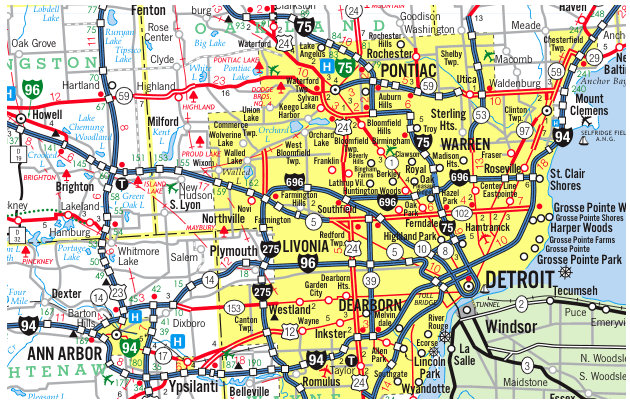 Our Construction company is Servicing Southeast Michigan, Detroit and the Tri-County area Wyane, Oakland and Macomb;

