
10 Frequently Tested Topics and Questions on the Michigan Residential Builder License Exam
10 Frequently Tested Topics and Questions on the Michigan Residential Builder License Exam
If you are preparing to take the Michigan Residential Builder License Exam, knowing what to study can make a significant difference in your preparation. The examination is administered through PSI, while the Michigan Bureau of Construction Codes develops the examinations based on the applicable construction codes, laws, and regulations.
Michigan’s prelicensure education requirements provide an excellent indication of the major areas prospective builders are expected to understand. Required education includes business management, estimating and job costing, design and building science, contracts and liability, marketing and sales, project management and scheduling, the Michigan Residential Code, and Michigan construction safety standards.
The questions below are representative practice questions, not actual PSI examination questions. They are based on recurring subject areas relevant to Michigan residential builders.
1. When is a Michigan Residential Builder License required?
Practice Question:
A contractor agrees to construct a new residential structure for a homeowner in Michigan in exchange for compensation. Which statement is generally correct?
A. A license is required only if the project exceeds $50,000.
B. A Residential Builder license is generally required for this type of compensated residential construction work.
C. A license is required only for commercial construction.
D. No license is required if the homeowner supplies the materials.
Correct Answer: B
Michigan regulates individuals engaged in constructing residential structures, as well as certain repair, alteration, addition, and improvement work performed for compensation. These activities fall under the state’s Residential Builders and Maintenance & Alteration Contractor licensing requirements.
Exam Tip: Don’t assume that calling yourself a “handyman,” subcontractor, designer, or installer automatically eliminates licensing requirements. Pay attention to what work is being performed and whether it is being performed for compensation.
2. What subjects are important for the Michigan Residential Builder examination?
Practice Question:
Which of the following is one of the subject areas included in Michigan’s required residential builder prelicensure education?
A. Stock market investing
B. Business management, estimating, and job costing
C. Automotive repair
D. Real estate appraisal
Correct Answer: B
Michigan requires 60 hours of approved prelicensure education for Residential Builder and Maintenance & Alteration Contractor applicants. The required subject areas include business management, estimating and job costing; design and building science; contracts, liability and risk management; marketing and sales; project management and scheduling; the Michigan Residential Code; and Michigan construction safety standards.
Exam Tip: Don’t study only building-code provisions. Business practices, contracts, estimating, scheduling, and safety are also important parts of the builder’s responsibilities.
3. Which residential code should a Michigan builder study?
Practice Question:
A builder is preparing for a residential construction project. Which code contains the primary residential construction requirements applicable in Michigan?
A. Michigan Residential Code
B. Michigan Commercial Building Code only
C. National Electrical Code only
D. Michigan Mechanical Code only
Correct Answer: A
Michigan identifies the Michigan Residential Code as the code containing residential requirements. The Michigan Department of Licensing and Regulatory Affairs currently lists the 2015 Michigan Residential Code as the residential code, while the 2021 Michigan Building Code applies to building-code work covered by that code.
Exam Tip: Know which code applies to the type of project you are working on. Do not automatically assume that the commercial building code is the primary reference for a one- or two-family dwelling.
4. What is the importance of contracts?
Practice Question:
Why is a detailed written construction contract important for a residential builder?
A. It eliminates all construction defects.
B. It establishes the parties’ responsibilities, scope of work, payment terms, and other contractual obligations.
C. It replaces the building code.
D. It eliminates the need for building permits.
Correct Answer: B
Contracts are an important part of residential construction because they establish the agreement between the builder and the customer. Michigan’s prelicensure curriculum specifically identifies Contracts, Liability, and Risk Management as one of the required subject areas.
A good construction contract should clearly identify such items as:
- Scope of work
- Contract price
- Payment schedule
- Allowances
- Change orders
- Start and completion expectations
- Responsibilities of the homeowner and contractor
- Materials and specifications
- Warranty provisions
- Permit responsibilities
- Dispute procedures
Exam Tip: Read questions carefully when they involve contracts. The correct answer often depends on who has responsibility for a particular obligation.
5. What is the purpose of estimating and job costing?
Practice Question:
A builder estimates that a project will require $35,000 in labor and materials. During construction, the actual cost reaches $42,000. What does job costing help the builder identify?
A. The color of the building
B. The difference between estimated and actual project costs
C. The property’s zoning classification
D. The required electrical service size
Correct Answer: B
Estimating establishes expected project costs before construction begins. Job costing allows the builder to compare actual costs with the original estimate.
This is particularly important for:
- Labor costs
- Material costs
- Subcontractor costs
- Equipment
- Overhead
- Permits
- Waste
- Change orders
- Profit margins
Exam Tip: Understand the difference between an estimate, actual cost, overhead, markup, and profit.
6. Why are change orders important?
Practice Question:
A homeowner asks a builder to add an additional window after construction has begun. What is generally the best practice?
A. Perform the work without documenting it.
B. Refuse every change requested by the homeowner.
C. Document the change, its cost, and any effect on the schedule.
D. Allow the subcontractor to determine the price after completion.
Correct Answer: C
Changes to the original scope can affect both the project’s cost and schedule. A properly documented change order can establish what is being changed and how the change affects the contract.
A change order may identify:
- Description of the change
- Additional or reduced cost
- Labor and material changes
- Schedule impact
- Revised completion date
- Approval by the appropriate parties
Exam Tip: Questions involving change orders often test whether you understand the relationship between scope, cost, documentation, and scheduling.
7. What is the builder’s responsibility regarding construction safety?
Practice Question:
Which topic is specifically included in Michigan’s residential builder prelicensure education requirements?
A. MIOSHA construction safety standards
B. Automobile safety standards
C. Food-service regulations
D. Marine construction standards
Correct Answer: A
Michigan specifically requires prelicensure education covering Michigan Construction Safety Standards.
Safety considerations can include:
- Fall protection
- Excavation safety
- Ladders
- Scaffolding
- Personal protective equipment
- Electrical hazards
- Material handling
- Jobsite housekeeping
- Hazard communication
Exam Tip: Don’t treat safety as a minor subject. Michigan specifically identifies construction safety as part of the required builder education.
8. Why is project scheduling important?
Practice Question:
A builder schedules framing before the foundation has been completed and inspected. What is the most likely problem?
A. The project will automatically cost less.
B. The project sequence may be disrupted because subsequent work depends on completion of earlier activities.
C. The building will automatically receive a larger permit.
D. Scheduling has no relationship to construction costs.
Correct Answer: B
Construction is a sequence of dependent activities. Effective project management requires the builder to coordinate inspections, subcontractors, materials, deliveries, and work activities.
A basic construction sequence might include:
- Site preparation
- Excavation
- Footings and foundation
- Foundation inspection
- Floor framing
- Wall framing
- Roof framing
- Exterior enclosure
- Rough mechanical, electrical, and plumbing work
- Insulation
- Interior finishes
- Final inspections
Exam Tip: Understand critical sequencing and scheduling dependencies, not simply individual construction tasks.
9. Who must be licensed as a residential builder salesperson?
Practice Question:
An individual receives compensation for soliciting or securing residential construction business on behalf of a Michigan Residential Builder. What licensing issue may apply?
A. The person may need to be licensed as a Residential Builder or M&A Contractor salesperson.
B. No license is ever required for sales activities.
C. Only a real estate license is required.
D. The person automatically becomes a residential builder.
Correct Answer: A
Michigan states that a person who, for compensation, solicits or secures business for a Residential Builder or Maintenance & Alteration Contractor must be licensed as a salesperson. Michigan also states that a salesperson may be licensed to only one builder or M&A contractor.
Exam Tip: Questions involving salespersons can be easy to overlook. Pay attention to the words “for compensation,” “solicits,” and “secures business.”
10. What is the best way to prepare for the Michigan Builder Exam?
Practice Question:
Which preparation strategy is most appropriate for a Michigan Residential Builder examination?
A. Study only memorized practice questions.
B. Study the applicable code, laws, rules, safety requirements, and business subjects.
C. Study only construction terminology.
D. Ignore the reference materials identified for the examination.
Correct Answer: B
The Michigan Bureau of Construction Codes states that its examinations are based on the applicable code, law, and rules governing the trade. PSI provides examination information and reference-material information through its Candidate Information Bulletins.
Michigan also identifies the Michigan Residential Code and Michigan construction safety standards as required areas of prelicensure education.
Exam Tip: The goal should not be to memorize a collection of practice questions. Instead, learn how to find and understand the applicable requirement in the reference material.
Bonus: 5 Topics You Should Know Before Test Day
In addition to the questions above, candidates should spend substantial study time on these areas:
1. Michigan Residential Code
Understand where to find requirements involving:
- Foundations
- Footings
- Framing
- Roofs
- Stairs
- Guardrails
- Handrails
- Windows and doors
- Insulation
- Ventilation
- Fire protection
- Structural requirements
2. Business Management
Be comfortable with:
- Estimating
- Job costing
- Overhead
- Markup
- Profit
- Scheduling
- Record keeping
- Project management
3. Contracts and Liability
Study:
- Written contracts
- Scope of work
- Change orders
- Payment terms
- Liability
- Risk management
- Customer responsibilities
- Contractor responsibilities
4. Construction Safety
Review Michigan construction safety requirements and understand common jobsite hazards, particularly:
- Falls
- Excavations
- Ladders
- Scaffolding
- Electrical hazards
- Personal protective equipment
5. Licensing Laws and Regulations
Understand the difference between:
- Residential Builder
- Maintenance & Alteration Contractor
- Residential Builder Company
- Salesperson
- Subcontractor
- Employee
Final Thoughts
Passing the Michigan Residential Builder License Exam requires more than memorizing construction terminology. A successful candidate should understand construction codes, business practices, contracts, estimating, project management, safety, and Michigan licensing requirements.
Michigan currently requires applicants for a Residential Builder or Maintenance & Alteration Contractor license to complete 60 hours of approved prelicensure education, followed by the required application and examination process.
The examination itself is administered through PSI, while the Michigan Bureau of Construction Codes develops the examination content based on the applicable code, laws, and rules.
For the most reliable preparation, candidates should always verify the current PSI Candidate Information Bulletin and Michigan’s current code and licensing information before taking the examination, because codes, rules, and examination references can change.
Official Michigan Resources
- Michigan Residential Builder licensing information is available through the Michigan Department of Licensing and Regulatory Affairs.
- PSI provides examination scheduling and Candidate Information Bulletins.
- Michigan’s Bureau of Construction Codes provides information regarding applicable construction codes and reference materials.
Disclaimer: The questions in this article are original practice questions created from the subject areas relevant to Michigan Residential Builder licensing. They are not actual PSI examination questions and should not be represented as leaked or previously administered exam questions.

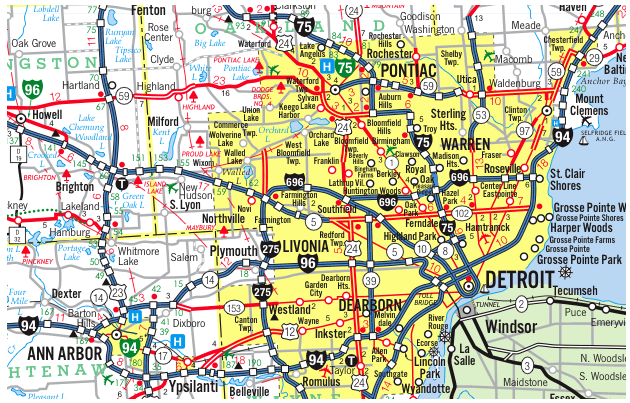 Our Construction company is Servicing Southeast Michigan, Detroit and the Tri-County area Wyane, Oakland and Macomb;
